AWS Control Tower Architecture
Document Control
| Field | Details |
|---|
| Project | AWS Control Tower Landing Zone |
| Version | 1.0 |
| Author | Anmol Nagpal |
| Last updated | 2026-07-01 |
Summary
AWS Control Tower is the governance layer for a secure, compliant, multi-account AWS landing zone. It uses AWS Organizations for account hierarchy, IAM Identity Center for access, AWS Service Catalog for Account Factory, CloudFormation StackSets for baseline rollout, CloudTrail and Config for auditability, and controls for policy enforcement.
This architecture is designed for centralized governance with decentralized workload ownership. Platform administrators own the landing zone, controls, identity model, and shared security services, while workload teams operate inside enrolled accounts that inherit the approved governance baseline.
Architecture Diagram
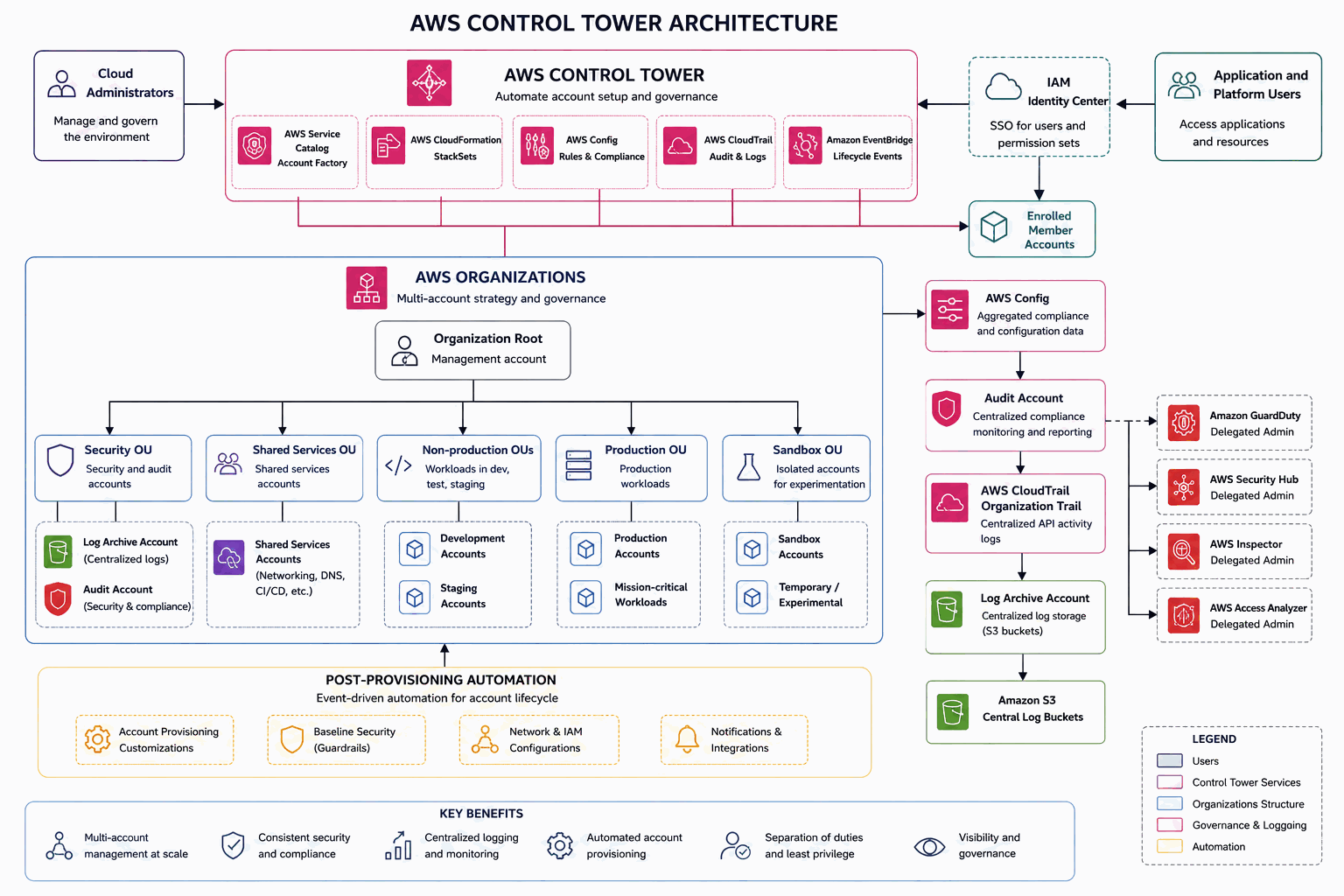
Landing Zone Structure
| Layer | Purpose | Design Notes |
|---|
| Organization root | Parent container for all OUs and accounts | Keep only required organization-wide policies at root. Apply environment-specific controls at OU level where possible. |
| Management account | Control plane and payer account | Hosts AWS Control Tower administration. Access should be tightly restricted and monitored. |
| Security OU | Central security and logging boundary | Contains Log Archive and Audit accounts by default. These are shared accounts and should not host workloads. |
| Log Archive account | Immutable audit log destination | Stores CloudTrail and Config delivery data. Restrict delete access, enable encryption, and retain according to compliance needs. |
| Audit account | Security review and delegated administrator account | Used for cross-account audit roles and delegated admin services such as GuardDuty and Security Hub. |
| Shared Services OU | Platform-wide shared services | Optional but recommended for DNS, networking, CI/CD, observability, backup, and artifact services. |
| Workload OUs | Business or environment workload isolation | Common examples: Development, Test, Staging, Production, Data, Security Tools. |
| Sandbox OU | Experimentation | Optional OU for short-lived experiments with budget controls and limited privileges. |
Core Control Plane Flow
- AWS Control Tower is configured from the management account.
- The landing zone setup creates or registers the required organization structure, shared accounts, IAM Identity Center configuration, and mandatory controls.
- Account Factory provisions accounts using AWS Service Catalog and AWS Organizations.
- AWS Control Tower assumes
AWSControlTowerExecution in enrolled accounts to apply baselines and controls.
- AWS CloudFormation StackSets deploy AWS Control Tower managed resources across accounts and Regions.
- CloudTrail and Config record governance events and configuration state.
- EventBridge receives lifecycle events that can trigger post-provisioning automation.
Account Vending Flow
| Step | Service | Description |
|---|
| 1 | Request channel | Account request is submitted through Account Factory, automation, or an approved platform workflow. |
| 2 | AWS Service Catalog | Account Factory standardizes required account parameters and account product lifecycle. |
| 3 | AWS Organizations | AWS account is created or enrolled and placed in the target OU. |
| 4 | IAM | AWSControlTowerExecution enables Control Tower to baseline and manage the account. |
| 5 | AWS Control Tower | Mandatory controls, baselines, logging, and audit roles are applied. |
| 6 | CloudFormation StackSets | Required baseline resources are deployed per account and Region. |
| 7 | EventBridge | Successful lifecycle events trigger optional automation such as security service enrollment, baseline networking, and notifications. |
Governance and Controls
AWS Control Tower controls apply at the OU level and affect accounts inside the OU. The management account is intentionally exempt from controls that could otherwise make the management account unusable; actions in that account should still be tracked through audit logs.
| Control Type | Purpose | Example Use |
|---|
| Preventive | Prevent disallowed actions before they happen, commonly through service control policies. | Deny disabling centralized logging in governed accounts. |
| Detective | Detect resources or configurations that violate policy, commonly through AWS Config rules. | Detect public S3 bucket access or unencrypted resources. |
| Proactive | Check resources before provisioning when supported. | Validate CloudFormation resources against policy before deployment. |
| Guidance | Expected Use |
|---|
| Mandatory | Enabled as part of the landing zone baseline. |
| Strongly recommended | Enable unless a documented exception exists. |
| Elective | Enable based on workload, compliance, and organizational requirements. |
Security Architecture
| Security Capability | Account/Location | Implementation Notes |
|---|
| Identity federation | IAM Identity Center | Use permission sets mapped to groups. Integrate with an external IdP when required by client policy. |
| Break-glass access | Management and security accounts | Maintain tightly controlled emergency access with monitoring and periodic testing. |
| Central logging | Log Archive account | Centralize CloudTrail and Config logs in encrypted S3 buckets with restricted access. |
| Security audit | Audit account | Use cross-account audit roles and delegated admin capabilities for visibility. |
| Threat detection | Audit or security tooling account | Delegate GuardDuty administration and aggregate findings across accounts and Regions. |
| Security posture | Audit or security tooling account | Delegate Security Hub CSPM and aggregate standards/finding status. |
| Encryption | S3, KMS, service integrations | Use customer managed keys when required by policy; rotate keys where supported. |
| Network segmentation | Workload accounts and networking accounts | Use separate VPCs per environment and centralized connectivity patterns as needed. |
Observability and Audit Flow
| Source | Destination | Purpose |
|---|
| AWS CloudTrail organization activity | Log Archive account | Audit account and API activity across the organization. |
| AWS Control Tower lifecycle events | CloudTrail, EventBridge, CloudWatch Events | Track completion or failure of landing zone, account, OU, baseline, and control operations. |
| AWS Config recorders and rules | Account-local Config plus aggregation | Detect resource configuration drift and detective control compliance. |
| GuardDuty findings | Delegated administrator account | Central threat detection and investigation workflow. |
| Security Hub findings | Delegated administrator account | Security posture management and standards compliance reporting. |
Extension Architecture
| Extension Area | Recommended Pattern |
|---|
| Account customization | Trigger automation from Control Tower lifecycle events after account enrollment succeeds. |
| Baseline infrastructure | Use Terraform, CloudFormation StackSets, or Account Factory customizations for customer-owned resources. |
| Security services | Use delegated administrator accounts instead of configuring every account manually. |
| Notifications | Send EventBridge events to SNS, Lambda, or ticketing integrations. |
| Network baseline | Deploy account VPCs, Transit Gateway attachments, DNS, and routing through controlled infrastructure pipelines. |
| Policy-as-code | Validate Terraform, CloudFormation, and IAM changes in CI before applying to governed accounts. |
Failure and Drift Considerations
| Scenario | Impact | Response |
|---|
| Manual edit to AWS Control Tower managed resources | Landing zone or control state may become unknown or drifted. | Reconcile through AWS Control Tower supported update/reset workflows. |
| Account created outside Account Factory | Account may be unmanaged or missing baselines. | Enroll the account or move it to an unmanaged OU with documented exception. |
| Failed account provisioning | Account may exist but not be fully baselined. | Review lifecycle events and Account Factory product status; retry supported update/enrollment workflow. |
| Control enablement failure | OU may not have expected governance coverage. | Review Control Tower activities, CloudFormation StackSets, Config rules, and service-linked roles. |
| Missing EventBridge automation trigger | Post-provisioning tasks may not run. | Ensure CloudTrail is active and EventBridge rules target the correct event names. |
Architecture Decisions
| Decision | Rationale |
|---|
| Use Control Tower as the landing zone authority | Provides prescriptive multi-account governance and reduces bespoke account setup. |
| Keep workloads out of management, Log Archive, and Audit accounts | Reduces blast radius and protects control plane, logging, and security review functions. |
| Apply controls by OU | Aligns governance with environment risk and account purpose. |
| Use Account Factory for account vending | Standardizes account creation, enrollment, and baseline application. |
| Use lifecycle events for automation | Avoids racing against account creation and triggers automation after Control Tower actions complete. |
| Delegate security services | Centralizes visibility while keeping member accounts manageable. |
References